SHROOPLE.
LIFE / BODY / CULTURE
FITNESS — FEATURE STORY

GIRLS, YOUR WORKOUT RULEBOOK NEEDS A REWRITE!

Why women might benefit from training differently — and why copying the guys at the gym isn’t necessarily the smartest move.

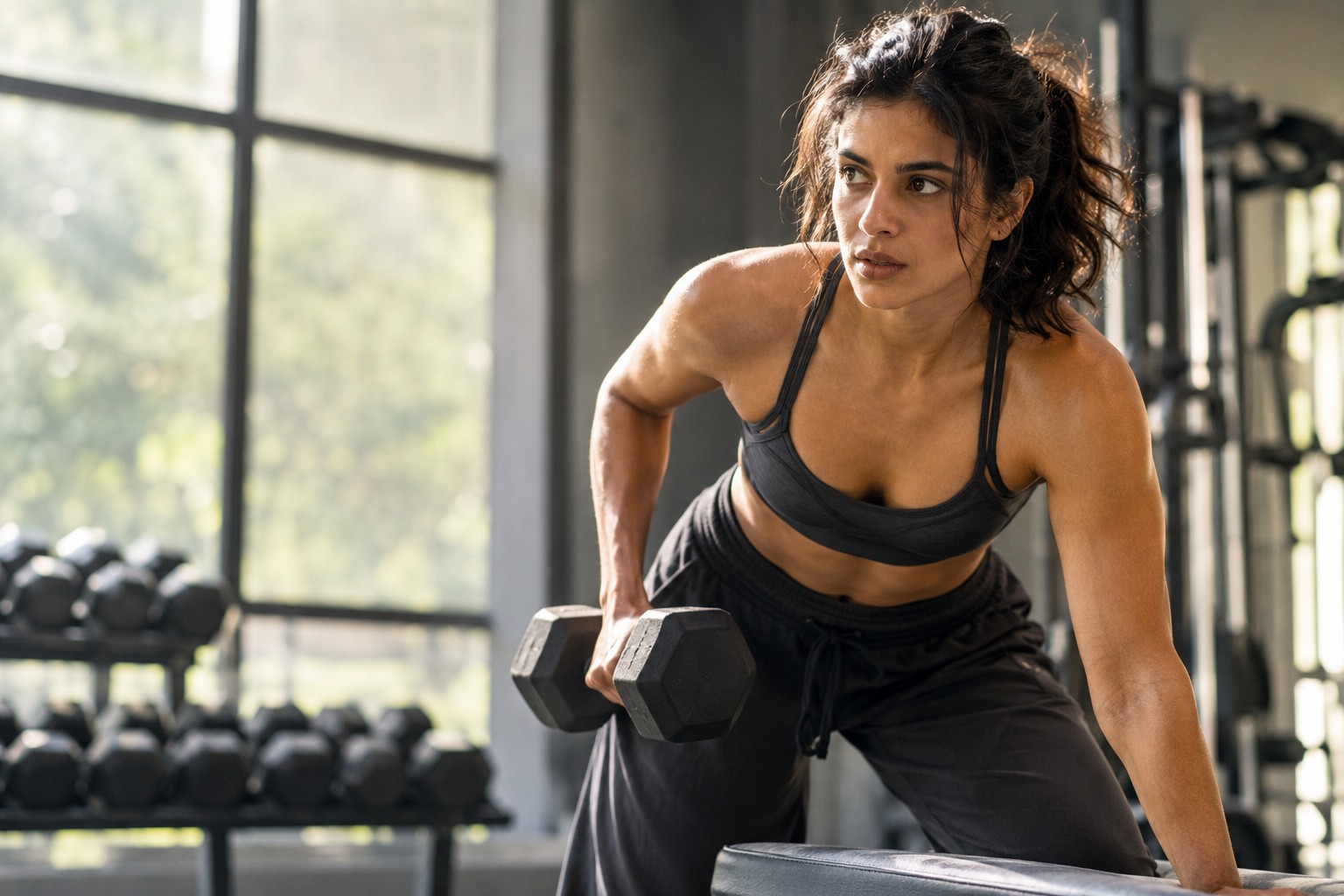
Woman in a dark sports bra performing a single-arm dumbbell row in a sunlit gym, looking off to one side.
THE SHROOPLE FITNESS EDITION

A different perspective on the science of training.

NINE THINGS WOMEN SHOULD KNOW ABOUT TRAINING DIFFERENTLY.

Walk into almost any gym and you’ll hear the same advice, delivered with the same confidence: lift like the guys, train like the guys, eat like the guys.

Here’s the thing. Women and men share the same fundamentals of strength training — progressive overload, good technique, enough protein, enough sleep, actually turning up. Nobody is rewriting physics. But some physiological differences, on average, may shape how people respond to certain approaches: how they use fuel, how quickly muscles tire, how they recover. “On average” is doing a lot of work in that sentence. Individuals vary enormously, and plenty of women will respond just like plenty of men.

So this isn’t a rulebook to replace the rulebook. Think of it as nine prompts to question the defaults, test what works for you and train with a bit more curiosity. Evidence-informed, occasionally cheeky and entirely open to being proved wrong by your own results.


Close-up of a hand scooping white powder into a protein shaker beside an open tub.
01

WOMEN MAY USE FUEL DIFFERENTLY

Your muscles run on a mix of carbohydrate and fat, and the blend shifts with how hard and how long you train. Some research suggests that, on average, women may lean a little more on fat and a little less on carbohydrate than men during steady endurance exercise. That’s an average across groups, not a rule for any one body.

Fitness level, intensity, session length, what you’ve eaten and other factors — hormonal ones included, though the evidence there is mixed — can all move the needle. So treat it as a reason to experiment, not a script. Notice how you feel in longer sessions, adjust what and when you eat around training, and don’t assume a fuelling plan built for someone else will suit you.

02

MORE REPS MAY HAVE A PLACE

In some studies, women have shown slightly better fatigue resistance than men, meaning they can sometimes hold a given percentage of their maximum for longer before the muscle tires. That finding comes mostly from lab settings and varies with the exercise, the muscle group and the person, so it’s a tendency, not a guarantee.

What it hints at is that sets in moderate-to-higher rep ranges can be a perfectly good tool, and that stopping a set well short of real effort may leave progress on the table. It does not mean every woman should automatically do more reps. Heavy sets build strength too. Choose rep ranges by your goal, your technique and how close to your limit you’re really training.

Woman pressing two dumbbells overhead in an industrial-style gym, mid-set.
Woman gripping two handles on a gym machine, hair flying, mid-effort in an industrial-style gym.
03

TRAINING VOLUME IS NOT ONE-SIZE-FITS-ALL

Volume — the number of hard sets you do for a muscle each week — is one of the levers that drives progress. More isn’t always better, though. The right amount depends on how long you’ve been training, what you’re aiming for, how well you sleep and recover and, crucially, whether you can keep the quality of every set high.

A beginner can make strong progress on a modest amount of work. Someone more experienced may need more to keep improving. If your lifts are slipping, your joints are grumbling or you dread every session, piling on volume probably isn’t the fix. Start with what you can recover from, add gradually and let performance, not guilt, tell you when to push.

“Your body isn’t a smaller version of somebody else’s.”
Woman landing a box jump in a bright gym with tall windows.
04

EXPLOSIVE MOVEMENT DESERVES ATTENTION

Strength isn’t only about slow, grinding reps. Power — producing force quickly — is what lets you sprint, jump, change direction and catch yourself when you trip. Jumps, medicine-ball throws, kettlebell swings and fast, controlled lifts all train it, and it tends to fade with age if you never practise it.

Women are often steered towards light, repetitive work and away from anything fast or athletic, which is a shame, because explosive training can be fun and quietly transformative. Start small: low box jumps, short sprints, crisp swings. Keep reps low, rest properly and stop before form frays. Power only counts when it’s clean.

Wide view of an industrial-style gym with a lone figure silhouetted in beams of window light.
05

CARDIO DOESN’T HAVE TO MEAN ENDLESS RUNNING

Running is wonderful, and if you love it, keep going. But cardiovascular fitness isn’t one thing, and it isn’t earned only by logging miles. Steady-state work — brisk walking, cycling, rowing, swimming — builds an aerobic base with relatively low stress. Intervals pack hard efforts into shorter sessions. Circuits, carries and sled work condition you while still building strength.

A mix tends to be more sustainable and more interesting than any single method, and the best option is usually the one you’ll actually keep doing. If you’re training for a specific goal, let that decide the balance. If not, choose variety and let enjoyment count as a feature, not a distraction.

Woman running on a treadmill in a gym, her ponytail flying behind her.
Woman performing a barbell back squat inside a power rack.
06

CONTROLLED REPS, BETTER MOVEMENT

Lifting a weight is only half the job; the other half is how you move it. Controlling the lowering phase, using a range of motion you can own and keeping your position steady gives the muscle more useful work and your joints a calmer life. Rushing reps, bouncing out of the bottom or letting momentum do the lifting often means the target muscle is doing less than you think.

Try a deliberate two-to-three-second lower, a brief pause where it’s safe to do so and a smooth, strong lift. Drop the weight if you have to. And good form isn’t one perfect shape: bodies differ. It’s about repeatable, controlled movement you can actually feel working.

07

MUSCLE FATIGUE AND METABOLIC STRESS

When a muscle works hard for a stretch it fatigues, and by-products of energy production build up in and around it. This is often called metabolic stress, and it’s behind that familiar burn. It may contribute to muscle growth, but it isn’t the whole story. Mechanical tension — challenging the muscle with enough load, through a good range, close to its limit — is generally considered the main driver.

Burning and next-day soreness are sensations, not scorecards. You can have a productive session without either, and you can be wrecked by a badly planned one. Judge a workout by what you can show for it: more reps, more weight, better control or a bit more ease over time.

Close-up of a sweaty woman leaning forward with her hands on her knees, catching her breath in a gym.
“More effort isn’t automatically better training.”
Woman sitting against a concrete wall between sets, head tipped back, with a water bottle beside her.
08

REST BETWEEN SETS IS PART OF TRAINING

Standing around between sets can feel like wasted time. It isn’t. Rest is what lets you repeat quality work, and how much you need depends on the exercise, the load and your goal. Heavy compound lifts and explosive work generally call for longer breaks — often a few minutes — so the next set can be performed at full strength. Lighter isolation exercises or conditioning circuits can get away with less.

If you’re getting weaker set after set, you may be rushing. If you’re drifting into a scrolling spiral, you may be resting too long. Use the clock as a guide, not a rule, and let your performance tell you when you’re ready to go again.

“Recovery is part of the workout.”
Woman lying on a rubber gym floor with her eyes closed, recovering after a workout.
09

RECOVERY AND TRAINING FREQUENCY

Training is the stimulus; recovery is where adaptation actually happens. How often you should train depends on your schedule, your sleep, your stress, how hard your sessions are and whatever else life is throwing at you. Some people thrive on three focused sessions a week, others on five shorter ones. Neither is superior.

Sleep, enough food and the odd day where you simply do less all matter, and consistency beats heroics: a plan you can follow for months will outperform one you abandon after three weeks. If your performance is sliding, you’re constantly exhausted or your motivation has vanished, consider a lighter week before adding more. And if something hurts in a way that doesn’t feel right, speak to a qualified professional.

Woman seen from behind on a rooftop at dusk, with a city skyline glowing behind her.

TRAIN SMARTER.
NOT JUST HARDER.

Good training isn’t about blindly following somebody else’s rulebook. It’s about understanding your body, choosing the right approach and building a routine you can actually sustain.

This feature offers general information and isn’t medical advice. If you have a health condition or an injury, speak to a qualified professional before changing how you train.

SHROOPLE.
LIFE / BODY / CULTURE